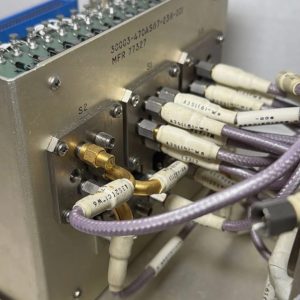
The Aviation Switching Module – NSN 4920-01-250-2696 (AS-IS / Untested) should be purchased with the understanding that no operational, calibration, serviceability, compatibility, or installation guarantee is being made.
The Aircraft Switching Module can form part of a specialized aviation system, while the Aerospace Switching Module requires identification through labels, technical documentation, connector configuration, and application records.
An Aircraft Electrical Switching Module can have commercial value for technicians, while an Aviation Electrical Control Module or Aerospace Electrical Control Unit requires qualified bench evaluation before operational consideration.
An Aircraft Switching Unit can support specialized signal or circuit management, but an Aerospace Power Distribution Module or Aviation Power Control Module may use different internal architecture and electrical requirements.
Identifying the Aerospace Switching Unit
Accurate NSN verification helps reduce purchasing errors and prevents an unrelated module from being represented as compatible equipment.
Complete identification increases the value of the Aviation Switching Module for restoration, research, inventory management, or component evaluation.
Evaluating Surplus Aircraft Electronics
The condition description should be understood as a limitation rather than a suggestion that the unit is probably operational.
Bench testing should begin only after technical documentation, circuit protection, connector identification, and safe power requirements are established.
Choosing an Aircraft Switching Module
An Aircraft Switching Module may provide circuit selection, signal routing, controlled connection, isolation, mode selection, or interface functions within compatible aviation equipment.
Switch movement can be checked gently for obvious binding or damage, but mechanical movement does not establish electrical operation.
Aerospace Switching Module Construction
Age, handling, impact, humidity, temperature changes, contamination, and long-term storage can affect both mechanical and electrical condition.
Connector damage can prevent proper mating or create electrical shorts even when the module enclosure remains intact.
Evaluating Aircraft Electrical Components
An Aircraft Electrical Switching Module should be inspected for overheated areas, burned insulation, damaged terminals, loose hardware, corrosion, moisture entry, broken controls, and signs of previous disassembly.
Seals, labels, inspection marks, tamper indicators, and original component arrangements may have historical or technical value.
Aviation Electrical Control Module Functions
Professional research should occur before any attempt to connect the Aviation Electrical Control Module.
High-resolution photographs can preserve readable details before cleaning or restoration.
Aircraft Power Switching Module Considerations
An Aircraft Power Switching Module may connect, disconnect, select, or manage compatible electrical power circuits when designed for that function.
Any successful limited test should be documented precisely without changing the overall status beyond what was actually verified.
Electrical Control Unit Restoration
An Aerospace Electrical Control Unit may combine switching, control, indication, interface, or distribution functions within one enclosed assembly.
Replacement components should match the required electrical, mechanical, thermal, and environmental characteristics of the original design.
Signal Switching Module Inspection
An Aircraft Signal Switching Module may route low-level, control, communication, measurement, or test signals between compatible equipment channels.
A complete accessory inventory improves the commercial presentation of the Aircraft Signal Switching Module.
Aviation Control Module Applications
An Aviation Control Module should be treated as one component within read more a larger system rather than a standalone universal controller.
A matching NSN or housing does not always confirm identical internal configuration when modifications or supersessions exist.
Choosing an Aircraft Switching Unit
Detailed condition reporting supports fair commercial evaluation.
Removable demonstration leads or external training fixtures may preserve originality better than permanent alteration.
Choosing an Aerospace Power Distribution Module
Internal conductive components can corrode or loosen during storage.
Preserving the original structure protects the Aerospace Power Distribution Module and its resale value.
Aircraft Electrical Control Unit Inspection
The unit should be photographed before and after any preservation work.
Functional evaluation should proceed in stages, beginning with research and non-powered inspection before controlled electrical testing.
Inspecting a Power Control Module
The NSN’s federal supply classification may provide useful context, but the exact role should still be researched through item-specific records.
Power-control components may retain electrical energy or contain circuits requiring special handling depending on internal design.
Aircraft Electronic Switching System Integration
System diagrams can help identify required inputs, outputs, grounds, control logic, and companion components.
Repair documentation can help distinguish module faults from system faults.
Protecting an Aerospace Switching Unit
Connector caps should remain fitted, and the module should be supported without placing pressure on switches, knobs, cables, or mounting brackets.
Shipping should use cushioning that supports the enclosure while protecting protruding switches, connectors, controls, labels, and mounting points.
Aircraft Electrical Module Buying Considerations
Commercial evaluation should focus on total project suitability rather than the purchase price alone.
Transparent disclosure strengthens trust in an Aircraft Electrical Module transaction.
Evaluating an AS-IS Aircraft Switching Unit
A pre-purchase review should confirm the NSN, manufacturer, part number, serial number, markings, enclosure condition, connectors, switches, included accessories, storage history, modification status, and known application.
- Confirm that the identification plate shows NSN 4920-01-250-2696 and record every manufacturer number, serial number, contract marking, revision, and modification label.
- Do not interpret clean appearance, smooth switch movement, or intact labels as proof of electrical operation.
- Retain purchase records, photographs, labels, research, testing notes, and repair documentation with the module.
Aerospace Module Troubleshooting Process
A qualified technician may use controlled and current-limited equipment appropriate to the module design.
Test results should identify which circuits or functions were checked and which remain unknown.
Documenting Aviation Electronics Restoration
Original labels, wiring routes, fasteners, finishes, and component locations should be preserved whenever practical.
A repaired module may still require system-level testing or additional qualification before installation.
Buying NSN 4920-01-250-2696
The Aviation Switching Module – NSN 4920-01-250-2696 (AS-IS / Untested) offers stronger commercial appeal when its markings, controls, connectors, enclosure, accessories, history, and limitations are documented accurately.
The component should be judged according to complete project suitability rather than clean appearance, military-surplus interest, part-number rarity, or price alone.
Whether the item is purchased for restoration, training, parts recovery, display, testing, inventory, or professional repair, transparent information and controlled handling provide the strongest foundation.
With prompt attention to switches, connectors, wiring, enclosure condition, corrosion, labels, and internal components, the module can preserve its technical and commercial potential.